

Relief from anxiety in 19 seconds? A free method for increased energy, improved blood circulation, reduced swelling, and improved complexion? Studies prove that simply learning how to breathe correctly can have these remarkable effects throughout your body.
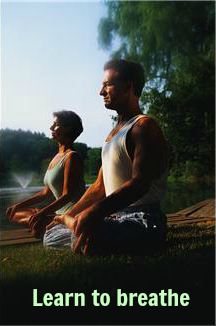 Breathing correctly can be as powerful as it is simple. The typical person only uses around twenty percent of their lung capacity, but with practice, they can learn how to tap into their lung’s full potential. Sending better oxygen content to all the cells of the body can bring dramatic changes in general health and mood.
Famous health guru, Dr. Andrew Weil, says that if he could only give one tip for better health, it would be to breathe properly. Proper breathing technique is central to the ancient practices of Yoga, Qi Gong, Ayurveda and other meditation disciplines. A clinical study* of thousands of participants over a 30-year period presents convincing evidence that the most significant factor in peak health and long life is how well you breathe.
*You can get the complete Framingham study at the National Institute of Health’s Database. http://www.ncbi.nlm.nih.gov/PubMed/.
Breathing correctly is critical in maintaining the level of oxygen for energy, keeping the correct pH levels in the body, and enough carbon dioxide for bodily functions. Healthy people make 93 per cent of their energy aerobically (“in the presence of oxygen,”) but poor breathing habits can reduce the amount of energy made aerobically to 84 per cent. Seventy percent of the elimination of wastes from the body is through breathing.
The good news is that poor breathing habits can be reversed. Among infants, correct breathing comes naturally. Observe a baby as it breathes to see its belly rise and fall with each breath. As we grow older, we are taught to “suck in that gut” and “puff out that chest” as we try to achieve as slim a waist as possible. Such resistance to the natural breathing posture restricts oxygen intake, which can lead to numerous physical as well as emotional problems.
“Bad” Breathing
Shallow “chest breathing” invites problems by delivering less air per breath into the lungs. Less air per breath leads to a higher number of breaths, putting in motion a series of physiological changes that constrict blood vessels. An imbalance between the oxygen and carbon dioxide levels in the lungs delivers less oxygen to the brain, the heart, and the rest of the body. Carbon dioxide (CO2,) is a vital gas that is produced by the body’s energy source: metabolism. The body’s ability to maintain a normal pH (the balance between acid and alkaline that regulates the body’s chemical reactions) depends on maintaining an adequate supply of CO2.
Too much oxygen and not enough carbon dioxide can create an agitated state. As you learn to exhale slowly, you conserve carbon dioxide and rebalance the system. However, too much carbon dioxide, and not enough oxygen, can create feelings of fatigue and depression. Learning to inhale slowly re-balances your system by taking in more oxygen. In extreme cases, a restricted supply of oxygen can contribute to anxiety, panic attacks, and even phobias. Less productive exhaling can also result in a buildup of toxins that would have been eliminated through breathing.
Stress, anxiety, and emotions all affect our breathing – the natural “fight or flight” response that increases respiration. As “civilized” people, we typically do not ease such state of arousal with immediate physical activity. Once breathing is in an aroused state, the physiological effects on the body remain after the stressful event has gone. Such arousal promotes rapid breathing leading to a metabolic imbalance where CO2 levels are too low and oxygen use is poor. The key element to many meditation disciplines is that breathing technique can affect one’s emotional state as much as one’s emotional state can affect one’s breathing.
“Bad breathing” is also performed through the mouth rather than the nose, especially during exercise or a stressful situation. Breathing through the mouth permits inhaling and exhaling large volumes of air quickly. This can lead to hyperventilation, diminished energy, and a weakening of health and well-being.
“Good” Breathing
It is easy to develop good breathing habits, but it takes practice. Most of us are completely unaware of our breathing – otherwise we would have to remember to inhale over 17,000 times a day! Breathing awareness and practice, or “breathwork,” is an important part of training for athletes, musicians, vocalists, and public speakers.
To achieve normal levels of oxygen and CO2 in your system, you begin by focusing your attention on breath! Your goal is to reduce the number of respirations from a standard of 12 per minute to as few as four per minute – which can be achieved with practice. Deep, slow breathing will feel unnatural to many who first try it and may be uncomfortable to some. After years of shallow “chest breathing,” some have a low CO2 concentration leaving them with a tight chest and malfunctioning diaphragm.
A slow inhale, followed by holding the breath, and concluding with an exhale twice as long as the inhale will help balance the CO2 level. One technique is called “4-7-8 Breathing” in which you inhale to the count of four, hold the breath to the count of seven, and slowly exhale to the count of eight. The slow exhale is key to most forms of breathwork, and critical to achieving stress reduction.
Bad Advice
“Take a deep breath” can be very bad advice to someone who is feeling anxious or is agitated. If such a person begins taking deep breaths, they are likely to experience an even more aroused state. A person prone to anxiety most likely is at or over their optimum CO2 level and needs to slow their respiration more than increase their intake volume through “take a deep breath.”
Such advice can lead to hyperventilation (breathing too fast.) The amount of carbon dioxide in blood generally regulates breathing and a low level of CO2 tends to make the nervous system more excitable. If carbon dioxide is released too rapidly, the arteries and blood vessels constrict and an insufficient supply of oxygen to the cells results, including blood (and oxygen) supply to the brain. Restricting oxygen supply to the brain can stimulate the sympathetic nervous system (fight or flight) and cause tension, anxiety, and mood swings. Low levels of oxygen in the brain has been associated with depression and other changes in brain waves.
Remembering to Breathe
Learning the proper breathing technique is important – remembering to practice that technique can become even more important. On a typical day, it is easy to become focused on a task (such as the computer or driving) and forget to breathe properly. The tendency is to revert into shallow “chest breathing” when focused. Regularly practicing diaphragmatic breathing, with measured inhale and exhale, and it will become the only breathing you do. But, like anything else, proper breathing is a learned skill and practice is critical.
Getting “lost” at a computer keyboard or within the pages of a good book happens to everyone. You will need a timer or similar alarm to remind you on a regular basis throughout the day to practice this skill. Kitchen timers work well as does a wristwatch alarm or cell phone alarm. As these require resetting and the audible alarm can be embarrassing in some situations, there is a “personal breathing coach” device on the market with a discreet, silent alarm (breathminder.com) that is effective.
Internet
 Articles regarding diaphragmatic breathing abound on the Internet. In addition to the many health benefits achieved through proper breathing technique, there are numerous web sites devoted to breathwork for sports, public speaking, singing, and musical instruments. Many sites incorporate breathwork into practice of meditation as well as natural healing and holistic medicine modalities. Search breathwork, diaphragmatic breathing, or simply healthy breathing to find an extensive array of materials.
Unfortunately, this information is not widespread in today’s medical community. Illness and Pathology, not Wellness, are the priority of most healthcare practitioners. In addition, things that are free and can’t be patented (like breathing) do not attract funding for research, so little finds its way into popular medical journals.
Breathe Some Life Into It
Breathwork is free and you already own the necessary equipment (lungs) so you and you can practice virtually anytime anywhere. You first want to evaluate your current normal breathing pattern, and then learn diaphragmatic breathing skills, and then to pace your breathing. Once you have achieved that level, the “trick” is to remember to practice your breathing and to perform it correctly. With time, these skills become your normal method of breathing and you begin to breathe some life into your life!

I love your article, and I am actually a Qigong teacher. Practicing Qigong is actually a breathing and moving meditation and it is the perfect way to practice deep, slow, even and gentle breathing. I love your 4-7-8. I will try this breathing rhythm in my practice. The out-breath in my app iSleep Deeply is more even. (apple and soon on androide) Check it out, I work a lot on breathing on that app to promote deep sleep. I would love to know what you think of it. Keep up the great work and research!
I stumbled across this quite by accident, but I’m glad I did! I’ve been practicing mindfulness to relieve anxiety for about 3 years now. It’s always good to get back to basics & this was a perfect read. Thanks for sharing!